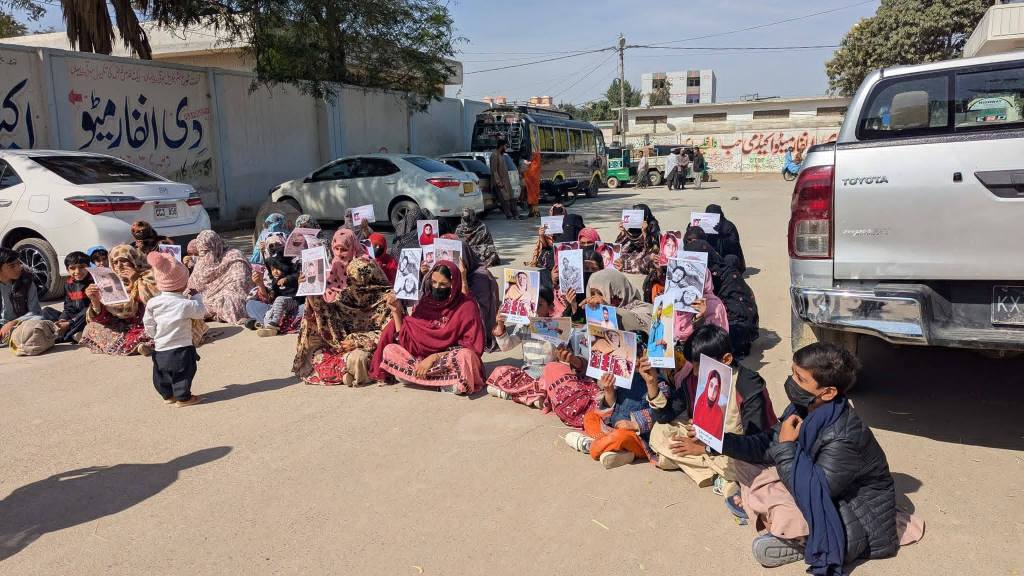
Hub, Balochistan: Anger and frustration are mounting in Balochistan as families of forcibly disappeared women and youths staged protests demanding accountability, accusing state institutions of systematic abductions, denial of legal remedies, and the use of enforced disappearances as a tool of fear and repression.
In Hub, the families of Nasreena Baloch, Hani Baloch, Khair-un-Nisa Baloch, Fatima Baloch, Fareed Baloch and Mujahid Baloch held a protest demonstration outside the Lasbela Press Club, calling for the immediate and safe recovery of the missing women.
Protesters said the targeting of women, including teenage girls and pregnant women, marks a dangerous escalation in a practice that has long plagued the province.
Speakers at the protest said that security forces, who previously targeted young men, are now extending enforced disappearances to women, inflicting severe psychological trauma on families and communities. They questioned what crimes the missing women had committed and demanded that, if any allegations exist, the women be produced before courts instead of being held in secret detention.
The protesters described enforced disappearance as a grave violation of human rights, the constitution, and international law, arguing that abducting individuals without charge or trial itself demonstrates their innocence. Families also alleged that police refused to register First Information Reports (FIRs), with Station House Officers declining even to receive their applications, effectively blocking all legal avenues.
“This denial of justice leaves families with no option but protest,” one relative said, warning that demonstrations would intensify if the women were not recovered and their whereabouts disclosed.
Addressing the gathering, Baloch Yakjehti Committee (BYC) leader Fauzia Baloch said that enforced disappearances of women in Balochistan have reached an alarming level and accused the authorities of deliberately spreading fear to silence political and social consciousness. She said women are sometimes publicly humiliated and at other times disappeared, turning the honour and dignity of the Baloch people into a target.
Fauzia Baloch sharply criticised the state’s claim of being an Islamic democratic republic, saying neither Islamic values nor democratic principles were visible in Balochistan. “Under the guise of democracy, authoritarianism prevails, and justice has become nonexistent,” she said, vowing that the BYC would continue its peaceful resistance against oppression and repression.
Meanwhile, the families of Junaid Hamid and Yasir Hamid, two brothers who were picked up by Pakistani forces in October 2024 from Hub Chowki and Kalat, continue to await their recovery. Despite press conferences, highway sit-ins, and protests in Hub, Quetta, and Islamabad, the brothers remain missing more than a year later.
According to the families, authorities twice assured them of the youths’ recovery and even signed written agreements, yet failed to honour their commitments. Social and political activists have also launched online campaigns demanding the brothers’ return, as the prolonged disappearance deepens fears for their safety.
Human rights organisations warn that enforced disappearances in Balochistan have persisted for over two decades, with a disturbing rise in cases where missing persons later turn up dead in “fake encounters.”
Groups, including the BY,C say the continued impunity enjoyed by perpetrators reflects a complete breakdown of the rule of law and have called on national and international human rights bodies to intervene.
As protests continue, families insist their demand remains simple and lawful: either produce the missing persons before courts or release them immediately, ending the long-running campaign of collective punishment against the people of Balochistan.

 Voice of Baluchistan