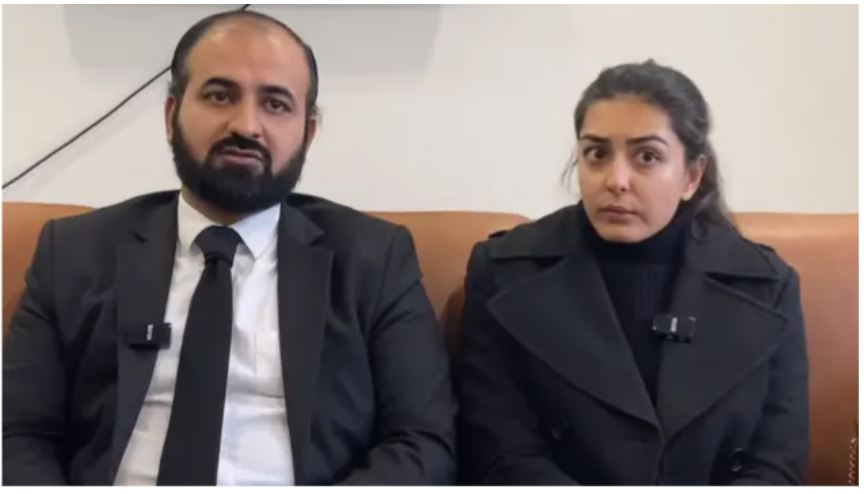
Islamabad, Pakistan: A local court in Pakistan’s federal capital has sentenced prominent human rights lawyer Imaan Mazari and her husband, Hadi Ali Chattha, to 10 years in prison each in a controversial case involving social media posts, a decision that has raised serious concerns among legal experts and human rights observers.
Mazari, widely known for representing victims of enforced disappearances and for her criticism of state institutions, was convicted under multiple provisions of the Prevention of Electronic Crimes Act (PECA). The court sentenced both defendants to five years under Section 9, ten years under Section 10, and two years under Section 26-A. Although the total sentence amounted to 17 years each, the court ordered all terms to run concurrently, resulting in an effective sentence of 10 years.
In addition to imprisonment, the court imposed fines totalling Rs 9 million on the couple.
According to the verdict, Mazari and Chattha were found guilty of posting what the court described as “anti-state” content on social media. The judgment further alleged that their posts promoted the narratives of banned organisations, including the Baloch Liberation Army (BLA) and Tehreek-e-Taliban Pakistan (TTP), as well as the Pashtun Tahafuz Movement (PTM). The ruling also cited references to political and rights activists such as Mahrang Baloch, Ali Wazir, and Manzoor Pashteen—figures who have long been associated with dissent and criticism of state policies.
Critics argue that the verdict reflects the increasing use of PECA to criminalise political expression and silence dissent, particularly targeting lawyers, journalists and activists. The broad and vague framing of “anti-state” content has repeatedly been challenged by civil society groups, who warn that such laws undermine constitutional protections for free speech.
The court stated that the prosecution had successfully proved its case, though the detailed reasoning behind linking social media posts to terrorism-related narratives has not been made public.
The conviction comes amid a wider crackdown on political activists and critics. Just a day earlier, Islamabad police had arrested Mazari and Chattha in a separate case, after which an anti-terrorism court sent both to jail on a 14-day judicial remand.
Human rights advocates say the timing and severity of the sentences signal an alarming escalation in the use of cybercrime and anti-terror laws against dissenting voices, further shrinking civic space in Pakistan.

 Voice of Baluchistan